EV road trips
Why Salida, Colorado, gave up downtown parking so Rivian drivers could fast-charge without unhitching
The site at 232 G Street opened with four DC fast chargers. City Council records and a launch-day video show why a driver with a camper would aim for one stall.
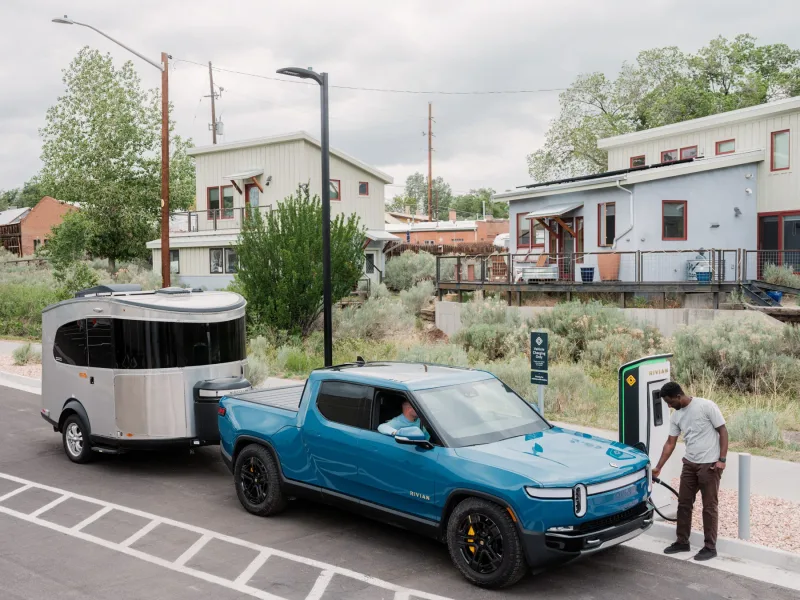

At the front of the blue Rivian R1T in Benjamin Rasmussen’s photograph, a man reaches for the charging cable. At the back is a little silver camper, still hitched. The truck is parallel to the curb in a downtown parking lot in Salida, Colorado. Getting a pickup and camper into that position took more than putting a pedestal within reach of the front fender. It took a decision by the city about who would get to use some of its parking spaces.
In January 2021, Salida city administrator Drew Nelson told the City Council that the eight proposed chargers and their equipment would occupy ground that held 18 parking spaces. He attributed most of the parking loss to making room for a Rivian towing a trailer. Only one of the four fast chargers would have a pull-through lane. Salida City Council’s January 5, 2021, meeting materials
What Salida had to fit between Second and Third streets
Rivian and city staff looked at several locations before choosing a city-owned lot at 232 G Street, next to the Safeway and the Monarch Spur Trail. The lease proposal covered about 2,900 square feet. Rivian would pay the city $50,000 for the site, contribute $2,700 for six trees along the trail and resurface the entire parking lot after construction. The city would retain the rest of the lot for people coming downtown.
The 18 spaces describe the footprint for the chargers, their parking spaces and the electrical equipment together. The council packet gives no separate space count for the pull-through. It does explain why a place for one camper took up so much of the discussion. A driver entering nose-first needs enough room to park a pickup. A driver who wants to leave with a trailer still attached needs room for the pickup, the trailer and the turn back out. City staff’s December 2020 proposal
The station opened on June 27, 2022, with four DC fast chargers for Rivians and four Level 2 Waypoints for drivers of compatible EVs. The Waypoints supply alternating current at a slower rate. Of the eight places to plug in, four offered a fast stop. One fast-charging lane let a driver pull straight through with a camper still attached. Rivian’s account of the opening
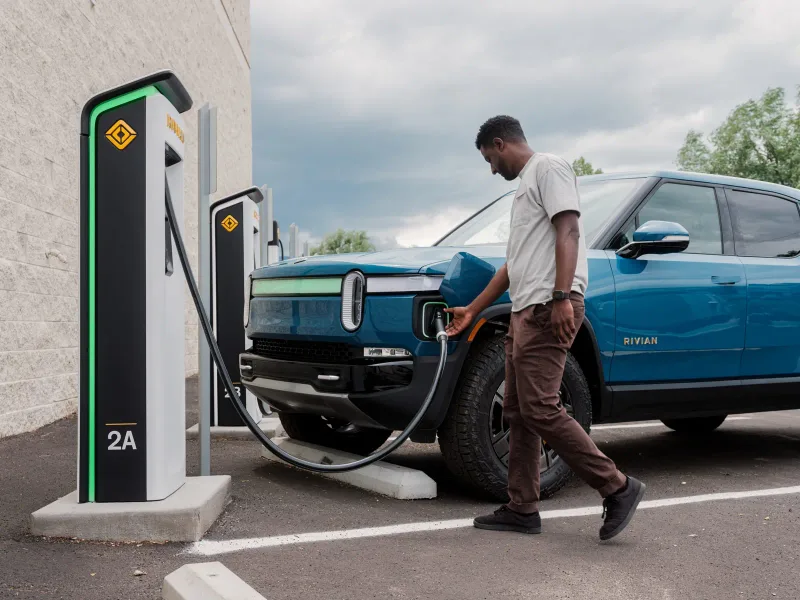

Rivian introduced the site as the first stop on its Adventure Network in a public post featuring Sara Eslinger, then the network’s director. Out of Spec Reviews filmed a charging visit in Salida on opening day. The photos from the opening also show two approaches a Rivian driver could take. In one, a blue truck faces a pedestal marked 2A. In Rasmussen’s wider photo, the truck sits alongside the charger with the camper following the line of the curb. Rivian’s launch-week post and Out of Spec Reviews’ opening-day video
The connector at 232 G Street
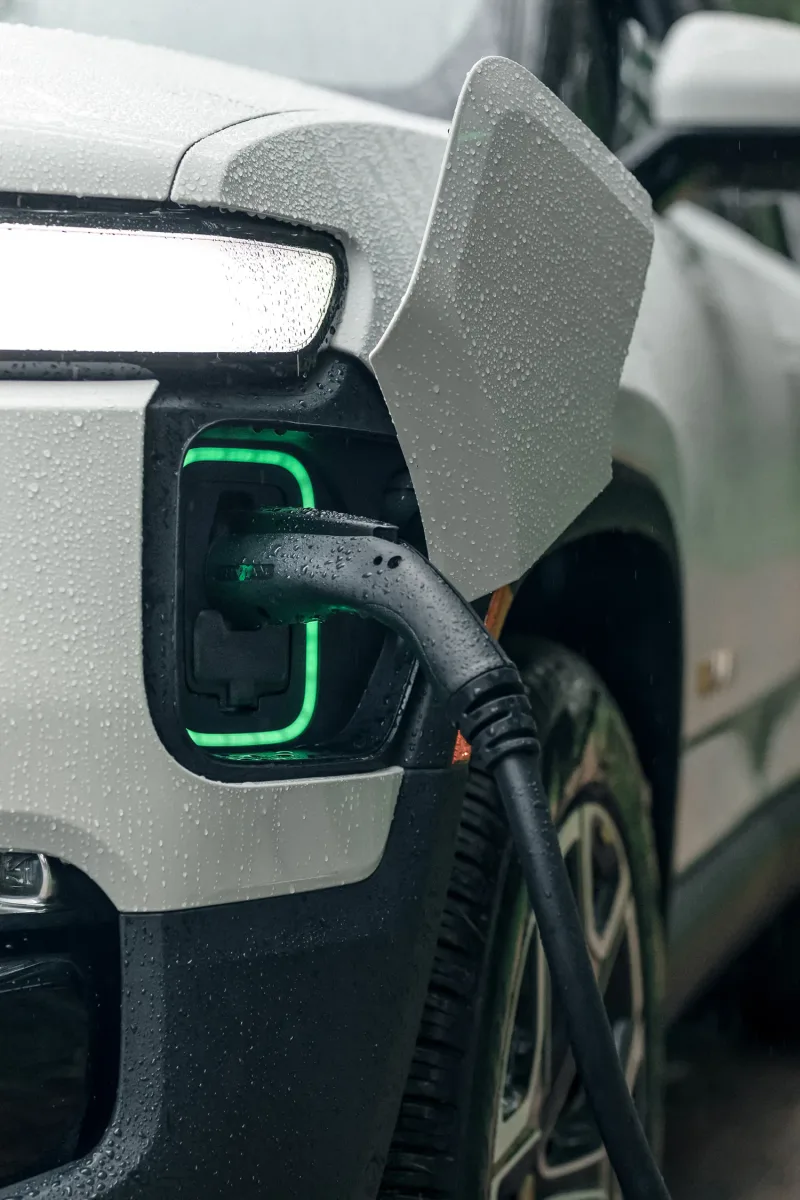
The federal Alternative Fuels Data Center’s November 22, 2026, record lists four DC ports at 232 G Street, each with a NACS connector and a 300-kilowatt rating. An early R1T has a CCS1 inlet. If you drive one, use Rivian’s current directions for your truck to identify the supported DC adapter before putting this stop on your route. The 300 kW in the station record is the port rating. It gives no charge time for a particular truck arriving with a warm battery, a cold one or half a pack already aboard. Federal station record for 232 G Street
When Salida opened, Rivian restricted the fast chargers to its own vehicles. It started opening parts of the network to other makes in late 2024. In May 2026 the company said nearly all sites could serve compatible vehicles and that it was adding NACS connectors alongside CCS1 across its network. For a driver pulling into Salida, the federal listing gives the connector at this address. The national rollout includes sites with different hardware. Rivian’s May 2026 network update
Even when a station reports two available fast chargers, another driver can be using the one pull-through. If you’re towing a longer camper than the one in Rasmussen’s photo, look past the empty pedestal before turning into the lot. Once the cable reaches your charge port, the back of the camper still needs to clear the entrance. A pickup with a port farther aft must stop somewhere else alongside the same cable, changing how much trailer sticks out behind it.

The backup charger and the drive over Monarch Pass
The federal locator lists another public fast charger across town at The Faricy Boys Automotive, 931 US-50. That station has CCS charging. Drivers of earlier CCS-equipped pickups have a second address to check if the pull-through on G Street is occupied. The dealership’s listing omits the turning room and stall layout. For a rig that has to stay hitched, a call to the operator about the entrance and exit is worth more than a second green marker on the route. Federal station record for 931 US-50
Westbound US 50 takes a driver from Salida over Monarch Pass toward Gunnison. Before leaving the charger, check Colorado’s COtrip map for closures and road conditions at the pass. A closure on the pass puts the next charging stop near Gunnison out of reach from this side, regardless of how many ports its station map shows available. Colorado Department of Transportation travel map
Rivian’s April 2024 R1T owner’s guide says that when the driver connects a trailer, the truck starts with the last trailer profile used. If last weekend’s trip was with the boat and today’s is with the camper, select the camper before heading west. A new profile initially shows dashes for trailer weight and estimated full-charge range while it learns the load. According to the guide, a slow, winding approach can take longer to produce an estimate. Rivian R1T owner’s guide, Trailer Profiles
The energy cost of a 60-mile leg makes the range question tangible. At two miles per kilowatt-hour, that leg would use 30 kWh. At 1.5 miles per kilowatt-hour it would take 40 kWh, a third more energy over exactly the same distance. Both are examples, before any reserve. Use the efficiency your loaded truck has recorded on comparable terrain to work out what you want in the battery before unplugging in Salida.
One photograph would help the next driver more than another shot of the charging screen. Stand far enough back to show the whole rig and where the trailer wheels track through the exit. Include the truck and trailer’s combined length. Salida’s records tell us why the city made room for that turn. A driver who has taken a full-size camper through it can show how much of that room it used.